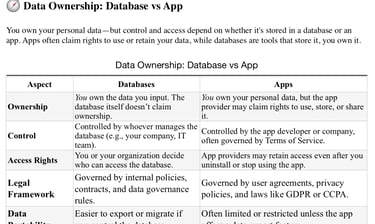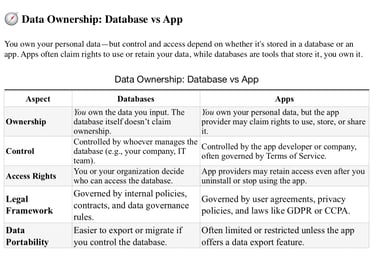
Data Ownership: Databases vs Apps
Dive into the facts about data ownership.
MICROSOFT ACCESS DATABASES
iBeauty Consulting Group
1/15/20262 min read
Data Ownership: Database vs Apps
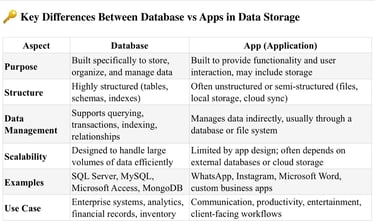
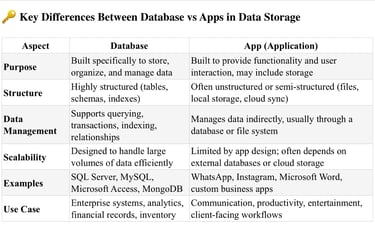
A database is a structured system designed to store, organize, and query data efficiently, while an app typically uses storage (like files or cloud services) to hold data but focuses more on user interaction and functionality. Databases are optimized for managing large, complex datasets, whereas apps often rely on databases or simpler storage methods behind the scenes
💸 Average Cost of Buying Your Data Back
There is no standard “buy-back” option. Most apps do not let you purchase your data back once you unsubscribe.
Data export is usually free under privacy laws like GDPR (Europe) and CCPA (California). Companies must provide a copy of your personal data if you request it.
Indirect costs: Some platforms may charge administrative fees for large or complex exports, but this is rare. The bigger cost is often time and effort—filing requests, waiting for processing, and reformatting the exported files.
Commercial datasets (not your personal data, but buying access to aggregated data) can cost hundreds to thousands of dollars per month, depending on volume and freshness.
📂 Formats Available When You Unsubscribe
When you request your data before unsubscribing, companies usually provide it in standard, portable formats:
CSV (Comma-Separated Values) → Easy to open in Excel or Google Sheets.
JSON (JavaScript Object Notation) → Structured, machine-readable, common for APIs.
XML (Extensible Markup Language) → Used for structured data exchange.
PDF/HTML → Human-readable reports, often for account summaries.
Proprietary formats → Some apps export in their own format, requiring their software to interpret.
⚠️ What Happens If You Don’t Export
Local loss: If you delete the app without exporting, data that is not synced is gone.
Server retention: Companies may keep your data for compliance or analytics, even after you unsubscribe.
No recovery: Once deleted from servers, your data cannot be bought back—it’s permanently erased.
Sources: Fresent Blog on SaaS Data Ownership1, LinkedIn on Organizational Data Ownership2, FasterCapital on Data Rights3